

Recreating the Ones We Love(d) in ‘Marjorie Prime’
The AI-focused play strikes a shockingly human tone.

It starts with a conversation between two lovers.
One is 85, stubborn and sweet. She’s slow to remember when her lover brings up a memory of them at the movies and the proposal afterward. The other is in his 30s, chipper and dapper. He’s curious about himself. He’s also a form of artificial intelligence.
This is the reality of “Marjorie Prime,” a play set in the near-distant future. In this world, you can speak to “primes”: AI companions modeled after people who have died.
Yet the imagined technology at the heart of “Marjorie Prime” feels almost beside the point. Instead, the play is moving not because of what it says about AI, but rather what it reveals about humans—particularly the way we remember the people we love.
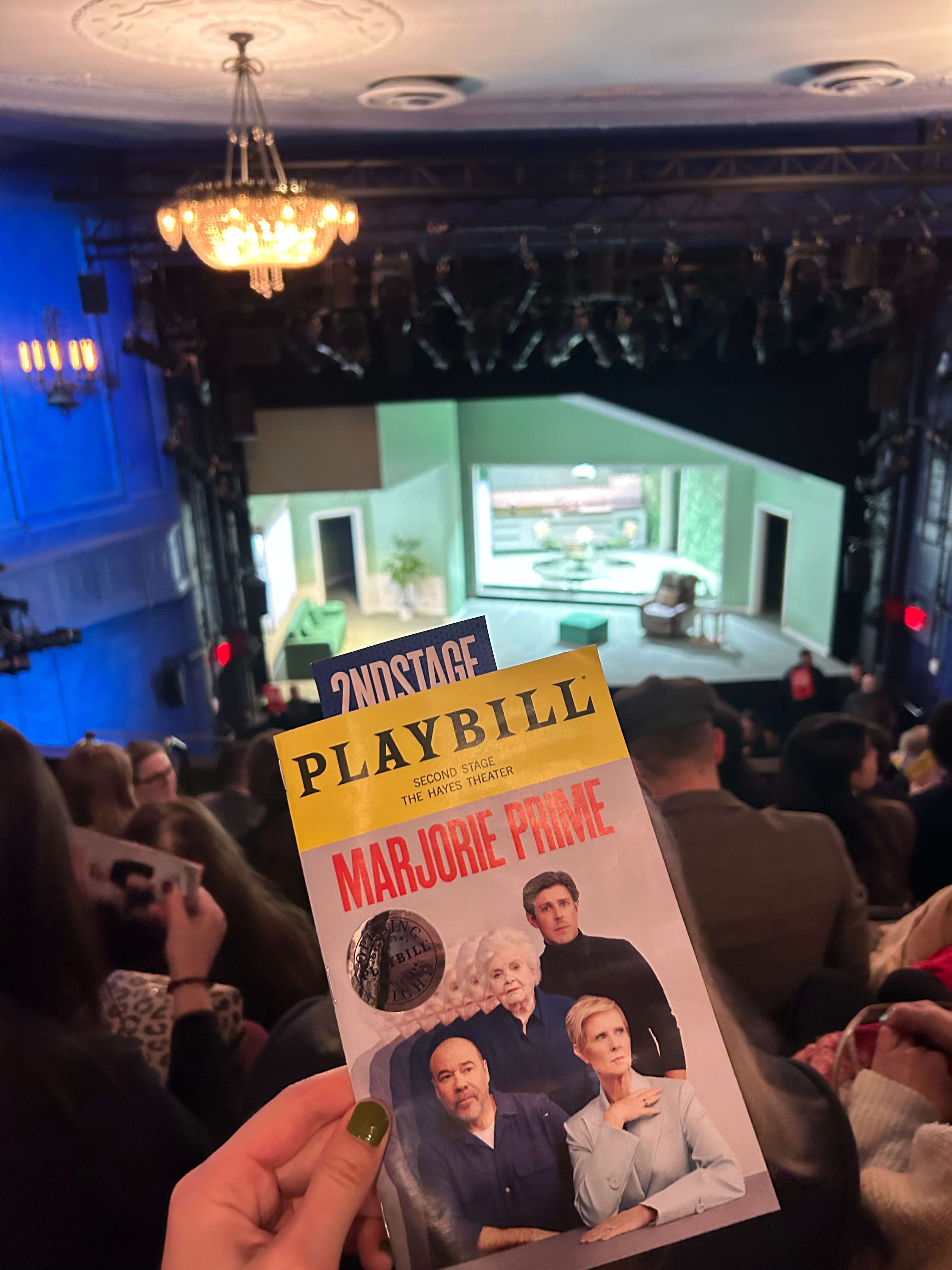
We’re introduced to primes through Marjorie herself, played by a divine June Squibb. At 96—over ten years older than the character she’s playing—Squibb is making headlines as the oldest actor to open a show on Broadway. The attention is well deserved. As Marjorie, she’s charming and witty, making the moments where she can’t remember or take care of herself more devastating.
Marjorie’s daughter, Tess, played by a formidable Cynthia Nixon, struggles to show up as a caregiver for her mother. There’s resentment and jealousy because her mother prefers to talk to an AI companion over her. Her husband, Jon (a kind, pure, and raw Danny Burstein) is an emotional counterweight, taking a caring and warm approach, committed to making the AI version of his father-in-law the most accurate he can be. Christopher Lowell rounds out the cast as Walter, Marjorie’s late husband and prime, performing with a stiffness that makes him feel almost real, but never quite alive.
Like any language learning model, the primes become more developed the more they speak to the humans around them. The more information they’re given, the more they can become like the deceased person they’re supposed to be.
The question becomes what information to give them—and what to hide.
What would you say to a blank slate to make it mold into a person you love? What are the details, traits, and quirks you would share? Jordan Harrison, the show’s playwright, handles this with remarkable tact and specificity. The play’s most affecting moments come from these granular acts of remembering, the details and memories loved ones choose to share. Take one conversation with Jon as he trains a prime:
People think you’re quiet but you’re not.
You like confrontation more than most people.
You’re good at it.
You’ve read everything.
You know the Latin names for things.
There’s beauty, and danger, not only in the details included, but in those left out.
We know a prime can never be a perfect substitute for someone we’ve lost, but “Marjorie Prime” asks a more unsettling question: just how imperfect do we want them to be? If we choose not to tell them traumatic parts of their life, can they still be an accurate representation of who they were?
These questions about what to teach the prime mirror Tess and Jon’s struggle with Marjorie as she loses her memory. What do you remind an aging parent of? If you smudge the edges or skip a chapter, what harm or good does it do?
It’s this moral conundrum that makes “Marjorie Prime” shine, not the technical elements it falls back on. Instead, the world-building in the play is where it falters. The set is perhaps most difficult to reckon with, a ’70s-esque kitchen and living room washed in green. It feels as if it’s stuck between a past and future, an inability to take a stance on just how much we’re supposed to lean into the futuristic, sci-fi angle of the show.
Perhaps that’s because it’s too close to home. When this show premiered in 2015, it likely got away with feeling too distant for us to grasp; now, it’s almost cringy when Tess snaps at her husband that “science fiction is here.” She rants about how technology is all-too-knowledgeable about the way we live and breathe, but we don’t need to be told that this AI reality is upon us. This show doesn’t need to be a warning signal.
“Marjorie Prime” doesn’t offer any revolutionary opinions about AI. Instead, it asks better questions about what makes us who we are. In the end, the primes aren’t shaped by algorithms or data, but by the stories we choose to tell about them—and the ones we don’t.

How to See ‘Marjorie Prime’
“Marjorie Prime” runs through February 15th on Broadway at the Hayes Theater.
How I found out about it: I’ve seen a lot of buzz about Cynthia Nixon in this on social media, in my email, and even on the subway, but more recent news about June Squibb being the oldest actress to open a Broadway show!
Why I went: I’m a bit wary of AI media in the same way I’m wary about COVID media: it has to be done really well to not feel cringy or immediately dated. While I don’t think this was perfect on the AI front, the human elements made it worth it.
How I got tickets: Thank you Emily for bringing me as a plus one to my first opening night!! How lovely to wash our hands next to Beanie Feldstein.
There are also a lot of ways to get discount tickets to this one! Second Stage Theater, the theater company that produced this show, has a 30 under 30 discount; add “30UNDER30” as your code while searching for tickets on their site and remember to bring your ID when picking them up. It’s also been showing up on TDF. And if you want to try your day-of luck, there are $49 digital rush tickets on the TodayTix app.
Happy cheap(er) theatergoing!
What Else I’ve Seen...
A lot, apparently! I collected the data on all the shows I’ve seen this year: which ones, whether they were on Broadway or not, how I got tickets, how much I spent. Not to be dramatic, but the numbers were shocking.
Stay tuned for a data report. In the meantime, you can try to guess just how many shows I saw:
All will be revealed in a substack soon…
Stay warm,
Zoe
For full transparency, I only skimmed the main section of this post, as I personally prefer to know as little as possible about shows before I see them. I am curious what this show brings to today’s world from an AI perspective given it premiered in 2014. Humans’ relationship with AI has changed significantly between then and now. I don’t know if you saw McNeal in Fall of 2024, but that was another show that seemed like it was trying to say something about humas and their relationship with AI, but it was, to be frank, odd. I don’t even really know what point it was trying to make, and while I appreciate a show that makes me think, at a certain point the value of the storytelling gets lost.
I believe the human aspect is what makes theatre theatre. I go to see live performers interacting and reacting in real time to each other and the audience, and musicals featuring live musicians. And I find that the Broadway storylines closest to my heart are all heavily focused on the humans (shoutout to my all time favorite Come From Away). So I agree on your front of the human elements making a show that discusses AI worth it.
I had no intention of seeing this show, but, 2ST’s 30 Under 30 makes it attractive. And I’ve never seen a show at the Hayes so I’d love to check it off my list. How do you see the role of AI evolving in today’s theatrical landscape? Is the human aspect still key to making a show both interesting to watch and financially successful?